Showing posts with label Baptisia. Show all posts

Friday, May 8, 2015

Baptisias!


DSCN2978
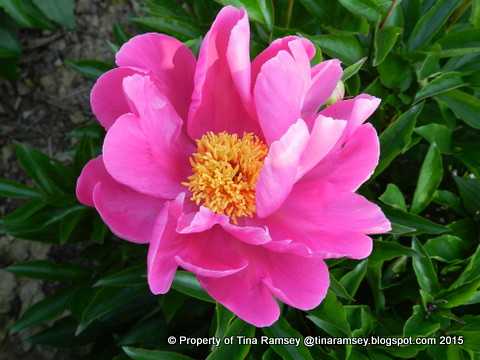
I hope everyone is enjoying their spring as much as I have been. Each year I keep telling myself spring doesn't get any better-but it does! This spring has been the best. Peonies and baptisias make it so. Perhaps I should've titled this post 'Baptisias AND Peonies' but I'll save a peony for later. Today we focus on the splendid baptisias. As a side note from a landscape designer (me!), peonies and baptisas are a great pairing in the garden. My peonies are just beginning to open up and they are quite beautiful this year.
DSCN2981
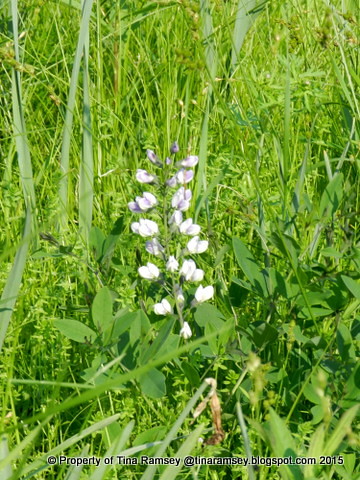
The real stars are the baptisias tho. This one is a while one growing in my little wildflower meadow. I have several baptisias planted 'in the wild' in a small grassy area on our property as well as several more in gardens and scattered around the property. Baptisias are tough, beautiful, easy care, and long lived perennials for all sorts of situations.
DSCN3032
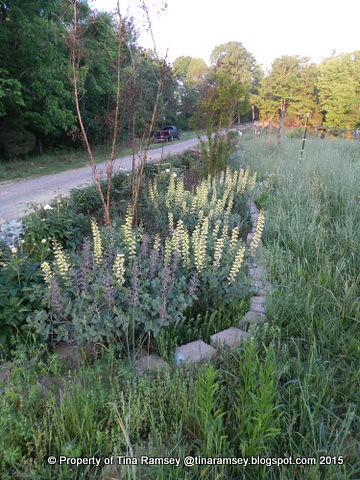
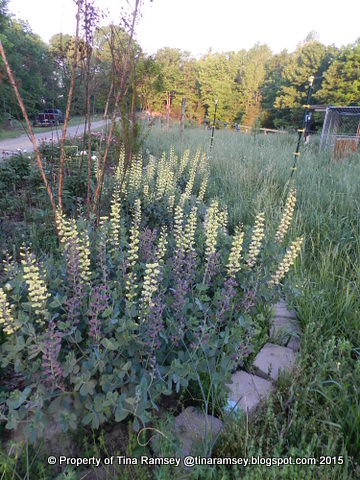
Here is the main grouping of baptisias. Wow! It is a sight to see. I guess I planted about six baptisias here. There are three or four 'Lemon Meringue' baptisias and were supposed to be three 'Dutch Chocolate' baptisias. I honestly don't know exactly how many of each are here because I haven't counted them but they sure do make an impact massed like this. When I purchased them from a nursery several years ago (on clearance), I think they were mislabeled or the labels somehow got mixed up. I moved all of these baptisias to the new garden in the fall of 2013. To see more about moving baptisias successfully (don't attempt to do it with plants older than three or four years old!) see this post from last spring. It will also show you just how much these baptisias have grown. You need to leave at least three or four feet between plants for their mature size. Don't skimp on this step!
DSCN3033
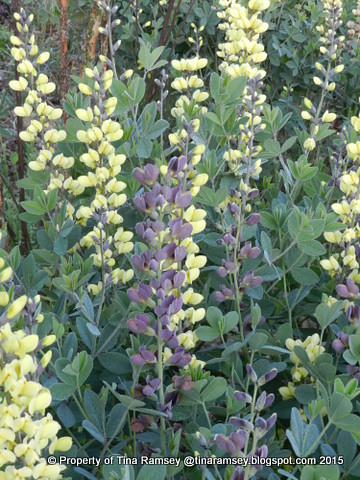
They grow between a grouping of crepe myrtles and border the edge of the large peony garden. There are over 40 different types of peonies in this garden and I thought the baptisias would look great with the peonies so that is where I planted them. I just love it. Can you see the 'Dutch Chocolate' baptisias? They are more subtle than 'Lemon Meringue' but are an integral part of this grouping nonetheless. Both 'Lemon Meringue' and 'Dutch Chocolate' baptisias are a Proven Winners plant. They are definitely winners in my book.
DSCN3034
Here is a better shot of the differences between 'Lemon Meringue' and 'Dutch Chocolate'. Don't you love their names?
DSCN3053
I'll finish this post with a shot of the main focal point of my new vegetable garden. I built this tiered strawberry bed from materials from my old garden just this past fall. And we are picking strawberries already! The rest of the vegetable garden is coming along and is almost done too. Soon I'll show you all of it....

in the garden....

Words and Photos Property of In the Garden Blog Team, In the Garden

Monday, May 12, 2014

Digging, Transplanting, and Growing Baptisias-Successfully


DSCN0939
I am still working on moving my garden, and work it is. I would perhaps be further ahead than I am but the soil on the farm is pure clay. That means that two days after a hard rain the soil is really hard and I can't really get a shovel into it to dig holes for planting. As such, I cannot plant constantly though I can dig continuously because the soil in my current gardens is beautiful, rain or shine. 

I did manage to dig some baptisias both this year and last year. It has been over a month now and I thought this post would be timely for anyone else who might ever consider digging up baptisias-think long and hard before you do! 

The above baptisias are 'Lemon Meringue' baptisias and were dug and transplanted last fall. The picture shows their current state on the farm and I must say they have done wonderfully. Mine are quite a pit paler in their yellowness than the website shows but I assure you, they were labeled 'Lemon Meringue' when I purchased them at a local nursery in the fall of 2012. Their light yellow presence is a nice foil for all of the peonies in this bed. I was very excited to see that they had made it through the winter. I had difficulty digging these baptisias but because they had only been in the ground about one year when I dug them, they were not so very bad. There were several long roots that extended several feet from the plant but I was able to dig them out and I cut some that I could not dig.  These baptisias have done quite well and the battle to dig them was well worth it to see them blooming in the new garden.
DSCN0585
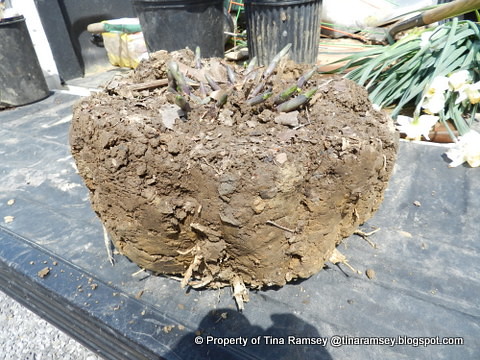
Enter this spring and the job comes up to dig up very established baptisias that have been in place for many years. This was a job!! It honestly took me a full day to get only four baptisias out of the ground. I gave up on the fifth as I did not think I'd be successful with digging it out of its spot so I left it alone. Everyone says baptisias have a taproot-no! To me a taproot is a single main root. Baptisias actually have several taproots and those taproots are woody. If you can imagine an octopus with tentacles going everywhere then you can imagine a baptisias roots. These roots delve very deeply into the soil. I bet mine went at least two feet or more deeply into the soil. This is a pretty long way for a perennial's roots to grow. I never could find the end of the roots though and settled with using strong loppers to cut off the roots that held me up. When all was said and done here is what one of the rootballs looked like just after digging. It was probably 18"-24" wide and more than a foot deep. It was also heavy.  Very, very, heavy.
DSCN0943

But the good thing with big and heavy rootballs is the fact that the plant will usually settle into its new spot fairly easily. That is what has happened with the baptisias I dug last month. They are safely ensconced in the Wildflower Field at Tiger Way Gardens and are in full bloom. It might be hard to see the blue spires but they are there! The rest of the greenery in the Wildflower Field is mostly weeds and also seedlings of wildflower seeds I sowed last fall. These baptisias should grow and continue to thrive and will hopefully produce more baptisias to spread around the Wildflower Field.  

All in all it was well worth it to dig up my baptisias because even though I could've gone out and purchased plants to plant in the field, that simply would not have been as much fun! Plus, my plants are bigger than what you can usually buy so I get a headstart on the plant sizes in the new garden....

in the garden....still planting away.

Words and Photos Property of In the Garden Blog Team, In the Garden

Friday, May 17, 2013

If I Grew Only ONE Rose It Would Be.....And Good Companion Plants for Roses


DSCN6988
If I could grow only ONE rose (it's impossible I know!) it would have to be the climber called 'Zephirine Droughin' (ZD)!

I do not take lightly my choice and have given it a great deal of consideration. There is really no contest in my garden (I have several cultivars and varieties including the ever popular Knockout roses). Nope, hands down ZD beats them all.
DSCN6986
ZD is a climber that will bloom sporadically all season long. It gives its main flush of blooms right about now. My ZD is two years old and receives no special care whatsoever. Gosh, I don't even fertilize it! I do have to train the canes. I decided last year once I saw how vigorous it was growing to train the canes to not only grow over my small arbor but to grow over the adjacent chainlink fence. That was a success as you can see! ZD is fairly thornless, has an old rose scent, does not get any defoliating leaf diseases, stays looking good well into the winter, and is an overall excellent rose. It would be my ONE and only if I could grow only one rose. Thank goodness that is not the case!
DSCN6969
Blooming nearby are several other perennials. Anything that blooms at the same time and looks good with other plants can be good companions. I just happen to think that some of these perennials are good companions for roses. The first is iris.
DSCN6989
Next up are baptisias. This one happens to be 'Carolina Moonlight'. It will be moving to a new home very soon on our land but for now it looks great in Tiger Gardens 1 near ZD.
DSCN6960
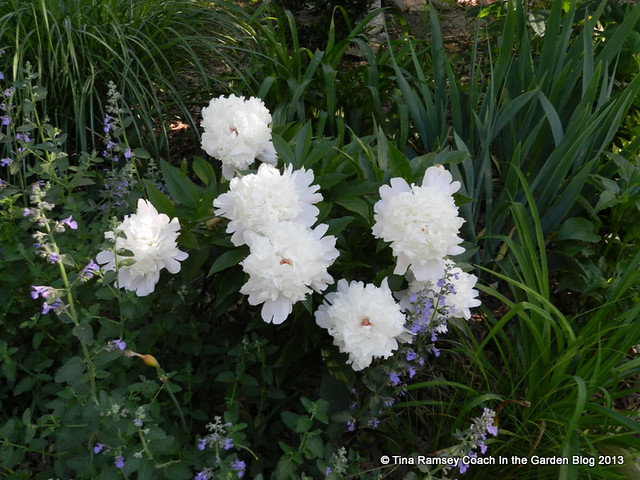
Peonies. Peonies and roses and irises and baptisias alone can make an AWESOME spring garden. Throw in some salvia and wow!
DSCN6954
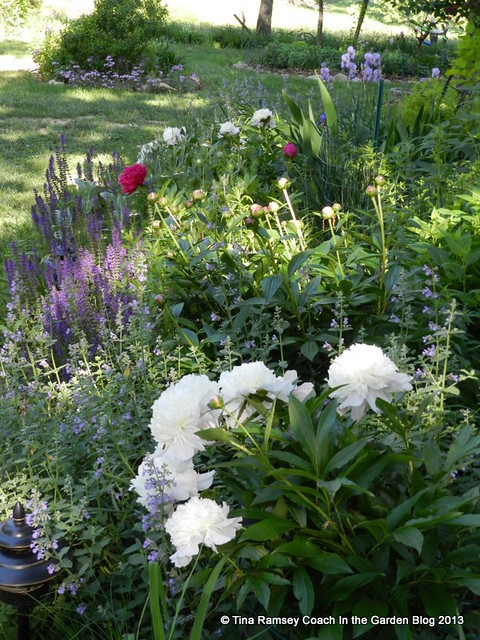
More peonies in the garden. These bloom with catmint. Catmint is an excellent companion with all sorts of roses and perennials. As a bonus catmint is drought tolerant, looks good all season, repeat blooms, and makes a fantastic groundcover under roses.
DSCN6953
Finally a long shot of some of the dozens of peonies in my garden. This is the rear center bed. Here you see some of that salvia ('May Night' shown here but there are many good types) I talked about, catmint, irises, and peonies. There are also roses nearby (directly across from this garden in the Sunny Perennial bed. All are super good bloomers....

in the garden....

What is your ONE and only rose?
Words and Photos Property of In the Garden Blog Team, In the Garden

Tuesday, August 30, 2011

A New Caterpillar In the Garden-An Exciting and Lucky Find

100_3780

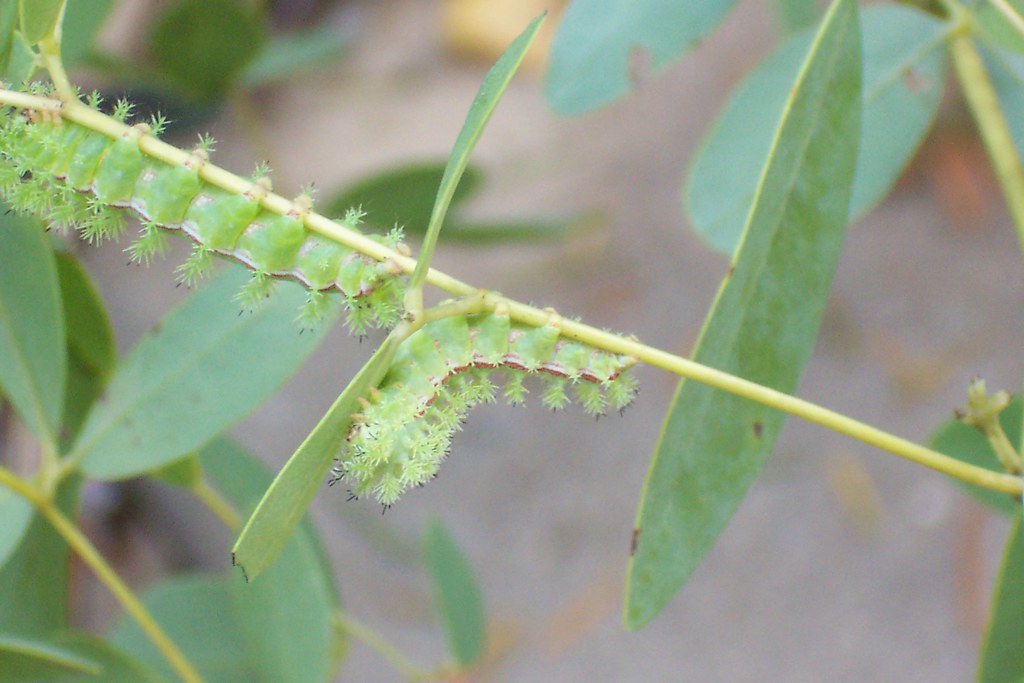
Today is a day off from work and as is usual, I am spending it in the garden. While gathering up a dead shrub I happened to glance down at a nearby baptisia and spotted three prickly looking caterpillars that I had not seen in the garden before. Hmmmm, I have several baptisias and some have been eaten to the stems so this caterpillar interested me. Not the mention that after my encounter with a prickly saddleback caterpillar I am very wary of prickly caterpillars in the garden. Prickly caterpillars can sting you severely so it is always best to leave them alone!! I kept my distance, took a few pictures and got on my computer to try to identify these caterpillars. 

I am not good at identifying caterpillars or even butterflies for that matter, but there is a handy site called Caterpillars that has a link to a  BuGGuide where you can look up what seems like millions of pictures of caterpillars and hopefully get an identification. Bingo! It only took me going through about 50 pictures before I found my caterpillar. It seems it is an instar of the Automeris moth.


The Automeris moth is a common moth of North America and one of its host plants is baptisia. These caterpillars in the above picture appear to be an early instar. The caterpillars of the Automeris go through five changes (instar stages) before they begin their metamorphosing into a cocoon to turn into a moth. 

I think the little caterpillars were a neat find in the garden but I am ever so grateful I did not brush up against these caterpillars because, not surprisingly, the prickly hairs STING! If you have never had the misfortune of brushing up against a stinging caterpillar such as these or the saddlebacks I can describe the pain for you. It is instantaneous and feels like someone poured burning water on your skin. The skin will turn red and look like it is burned. The pain will usually subside in a few days but I promise you won't ever forget the experience so beware when spotting new caterpillars....


in the garden....


Words and Photos Property of In the Garden Blog Team, In the Garden
Friday, May 6, 2011

The Three Purples, and Maybe a Little Yellow Too

100_2571

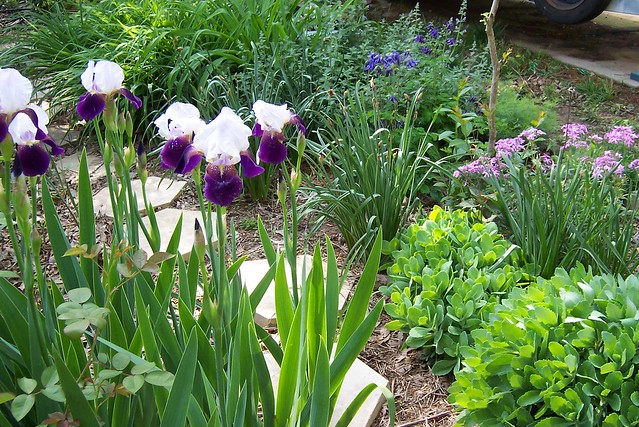
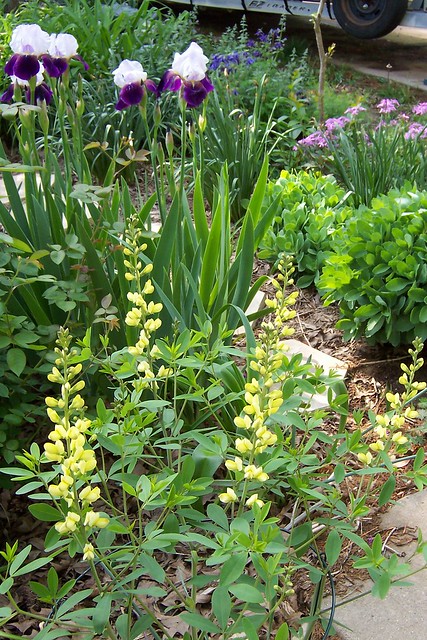
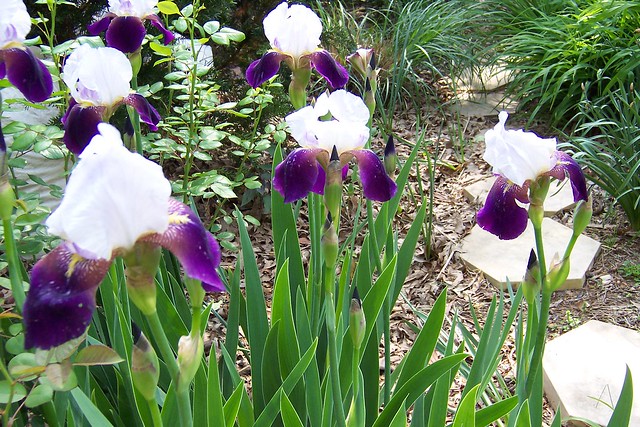
I was walking by the Sunny Side Perennial Border (a frontyard garden) when I noticed these three purples consisting of the white and purple irises, the lavender woodland phlox, and finally the dark purple of the columbine. At first I wanted to change out the irises due to the intense purple of the irises. I had thought an iris that matched the woodland phlox would be a better fit. But then I looked again and I liked what I saw. Sometimes it pays not to jump the gun. 


100_2572


The three purple combination is nice enough but then when you add in the 'Carolina Moonlight' baptisia it is like wow, not so bad. The yellow seems to offset the purples a bit. One reason this works is that yellow and purple are opposite of each other on the color wheel, they are contrasting colors so they work well. Another reason the yellow and purples work, at least in my humble opinion, is that all four of the flowers (baptisia, irises, woodland phlox, and columbine) have different flower shapes.


100_2573


When we look at the two low growing purples we find they work okay. Not only are the colors complementary (both are purples) but the textures of the foliage and surrounding perennials help with tones and differentiation.


100_2575


Here we see a close up of these oldie but goodie irises. These irises are fabulous by themselves but can be difficult to work with when pairing them in the garden with other perennials. But in my case I am happy with the effect and have decided to leave the purples with a bit of yellow alone....


in the garden....

Happy Mother's Day to all the mothers out there-especially to my dear mother. May she and all the mothers have lots of flowers in their lives on their special day and every day...
in the garden...

Words and Photos Property of In the Garden Blog Team, In the Garden