 I am still working on moving my garden, and work it is. I would perhaps be further ahead than I am but the soil on the farm is pure clay. That means that two days after a hard rain the soil is really hard and I can't really get a shovel into it to dig holes for planting. As such, I cannot plant constantly though I can dig continuously because the soil in my current gardens is beautiful, rain or shine.
I did manage to dig some baptisias both this year and last year. It has been over a month now and I thought this post would be timely for anyone else who might ever consider digging up baptisias-think long and hard before you do!
The above baptisias are 'Lemon Meringue' baptisias and were dug and transplanted last fall. The picture shows their current state on the farm and I must say they have done wonderfully. Mine are quite a pit paler in their yellowness than the website shows but I assure you, they were labeled 'Lemon Meringue' when I purchased them at a local nursery in the fall of 2012. Their light yellow presence is a nice foil for all of the peonies in this bed. I was very excited to see that they had made it through the winter. I had difficulty digging these baptisias but because they had only been in the ground about one year when I dug them, they were not so very bad. There were several long roots that extended several feet from the plant but I was able to dig them out and I cut some that I could not dig. These baptisias have done quite well and the battle to dig them was well worth it to see them blooming in the new garden.
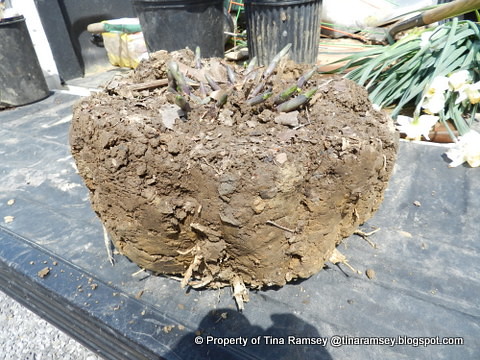 Enter this spring and the job comes up to dig up very established baptisias that have been in place for many years. This was a job!! It honestly took me a full day to get only four baptisias out of the ground. I gave up on the fifth as I did not think I'd be successful with digging it out of its spot so I left it alone. Everyone says baptisias have a taproot-no! To me a taproot is a single main root. Baptisias actually have several taproots and those taproots are woody. If you can imagine an octopus with tentacles going everywhere then you can imagine a baptisias roots. These roots delve very deeply into the soil. I bet mine went at least two feet or more deeply into the soil. This is a pretty long way for a perennial's roots to grow. I never could find the end of the roots though and settled with using strong loppers to cut off the roots that held me up. When all was said and done here is what one of the rootballs looked like just after digging. It was probably 18"-24" wide and more than a foot deep. It was also heavy. Very, very, heavy.

But the good thing with big and heavy rootballs is the fact that the plant will usually settle into its new spot fairly easily. That is what has happened with the baptisias I dug last month. They are safely ensconced in the Wildflower Field at Tiger Way Gardens and are in full bloom. It might be hard to see the blue spires but they are there! The rest of the greenery in the Wildflower Field is mostly weeds and also seedlings of wildflower seeds I sowed last fall. These baptisias should grow and continue to thrive and will hopefully produce more baptisias to spread around the Wildflower Field.
All in all it was well worth it to dig up my baptisias because even though I could've gone out and purchased plants to plant in the field, that simply would not have been as much fun! Plus, my plants are bigger than what you can usually buy so I get a headstart on the plant sizes in the new garden....
in the garden....still planting away.
Words and Photos Property of In the Garden Blog Team, In the Garden
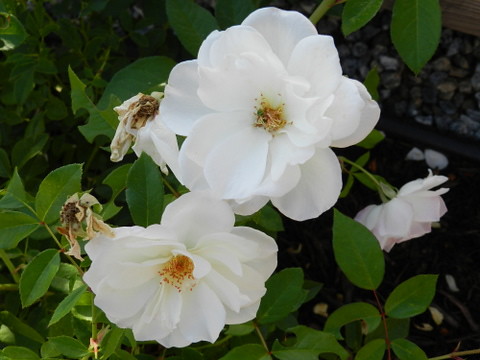 Welcome to sunny Alabama! Where roses grow and bloom freely and where October and November are the absolutely best months to visit. I am on just such a visit helping out with my granddaughter while her father recovers from a surgery. He is doing well. Farmer Fix-it remains at home holding down the fort and working the land. We are both so connected to that land I'm almost ready to pitch a tent and hang out there more often. Today's post is kind of about the land in that it has a lot to do with planting trees. I have already moved several trees to the land including some large ones. So far they are all doing really well. I love trees. Trees and shrubs are my thing in the garden and, as I've said before, perennials and flowers are the supporting players. I always start with trees in my garden then move to the shrubs. Trees are ever so important in southern Alabama because they provide much needed shade and cooling effects via their respiration (okay, so it may be subtle but it is there!)
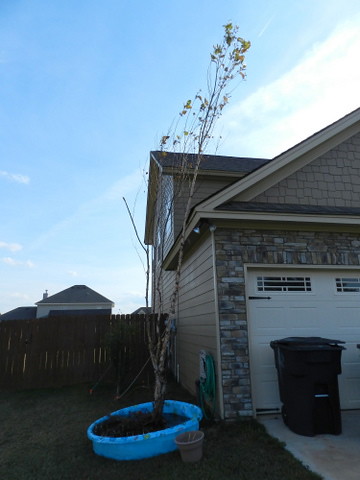 My daughter lives in a newer subdivision that used to be a tree farm. Yes, you heard that right. Prior to the houses being built here the red clay of the southern Alabama wiregrass region housed thousands of trees. The trees are mainly maples but there are also river birches in the mix. Unfortunately, the builder chose to take out all of the trees in parts of the subdivision, including the area where my daughter's house is located. Can you believe that? Beautiful trees and they are all just bull dozed over and disposed of? How could anyone build a house in the south and do away with all of the trees? The builder is now leaving more and more trees in the newer houses that are being built daily. A smart move. And I must say he is doing a good job of landscaping the lots. I even noticed the trees are being mulched and limbed up-properly! A really good thing as trees growing in tree farms can use some maintenance and the trees here all need it.
On my daily walk with my granddaughter I spotted a man and a skid steer. He was ripping trees out using the skid steer. The trees were all about 20 feet tall and taller. I was shocked by the roots-or lack of. I was thinking that 20+ feet tall trees would have big rootballs. Perhaps they did but when ripped out by a skid steer the rootball pretty much disintegrates. This fact is compounded by the sandy red clay of Alabama (it falls apart easily) and also by the distance the skid steer pushes the trees to get them out of the way. Nonetheless there are plenty of roots on the river birch I rescued.
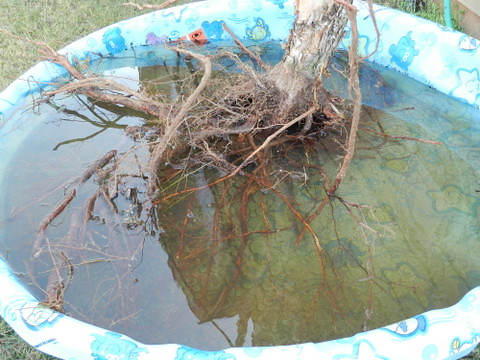 The major anchoring roots were damaged, as was the trunk, but there were still plenty of fine roots that I believe could sustain this tall tree-with some accommodations. The accommodations primarily consisted of pruning a good part of the tree off, and also pruning some roots and planting the tree in good quality soil with a root stimulator containing phosphorous. More on that later.

I found out there were two river birches available after speaking to the skid steer operator. He pointed me in their direction and said those were the only two river birches he was ripping out today. He also let me know that once he pulled out the trees "They would die." I did not agree or disagree with him. I just smiled and hiked over to where the trees were laying in the brush while he continued ripping out the beautiful maple trees. My granddaughter Adella did not know what to think of it all. She was my partner in crime on this day.
After surveying the birches we quickly walked home where I got my small hatchback car to haul the tree back to Christine's house. That was fun! The tree was about three times as long as my car. I placed it on top of the car, where I had laid some towels to keep it from scratching the car, tied it to the inside of the car with dog leashes, then headed back to the house. Luckily we had only a short distance to travel and the subdivision is not a high traffic area. Once I got it back to the house I propped it up in a swimming pool and tied it off to make sure it did not blow over. I was not really sure if Christine and her husband would want the tree. I had no worries in that arena. When Christine came home from work she was absolutely delighted with the tree! Her husband even said he likes it.
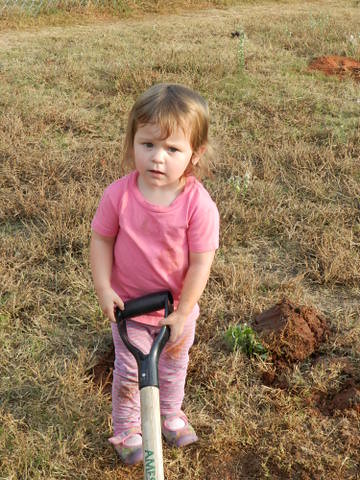 We decided to plant it the next day. This was a tough job even for me. I am very used to digging holes but geez, we actually could've used a pick axe to dig this hole! I thought sandy clay would be easy to dig in. The soil is probably more clay but it is gritty and sandy as well. Apparently the two mix well to form bricks when it is dry. The hole we needed to dig had to be at least five feet wide by about four feet. This is a big hole. The hole did not need to be deep. In our case just deep enough to sit the trunk into it so that it sat at the same level it was when it was in the tree farm area. Basically, our hole was only two to three feet deep. Ideally you want to dig holes two to three times the size of the root ball. We had no rootball and I felt that digging the hole big enough to match the roots was adequate-plus it was all we could do! Even with Adella's help it was a pretty hard and long job in the Alabama 80 degree heat!
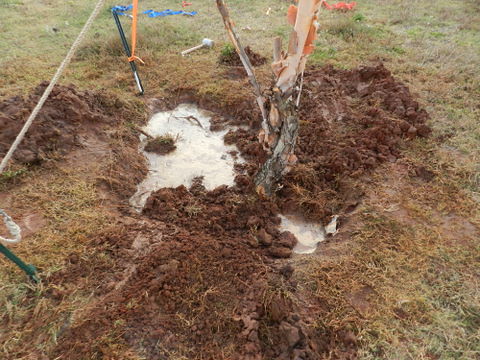 The thing that helped make the hole digging task easier was water. We dug a little then filled the hole with water. That water sat for a pretty long time without draining, but it did at least soften the soil along the edges a bit. We were also helped by the fact that the dogs had dug a really big hole already. The above picture shows the tree in place and partially filled in. We were short on soil but Christy has a compost bin full of compost. A wheelbarrow of that compost plus a large pot full of topsoil, and a phosphorous supplement helped us fill in the hole and stabilize the roots.
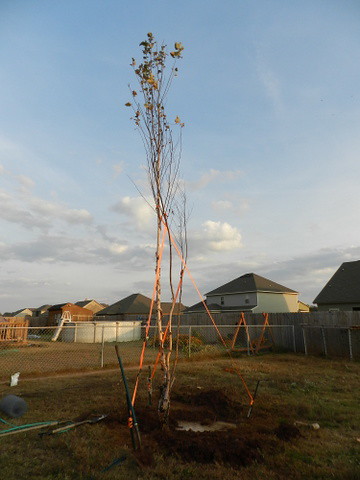 Just planting the tree and covering the roots would never have been enough to hold the tree in place. Prior to even filling n the hole we had to stake the tree. This involved a sledgehammer, a bruised knee when the sledgehammer's head did not meet with its target, and some strong arms. Finally, the stakes were in place and the tree was securely tied up with ratchet straps (it works!). I am not sure if this tree will make it or not but having done this very same thing a few years ago I can tell you river birches are TOUGH trees. Time will tell how this one will fare, but so far it is doing well and we are looking forward to shade....
in the garden....
Words and Photos Property of In the Garden Blog Team, In the Garden
 What do you do when you find you've planted the right tree in the wrong spot? Well move it of course. But-shhhh-I really didn't plant the right tree in the wrong spot, I simply changed my mind about having this river birch in it's location near my driveway and decided it had to go. My neighbor jokingly said, "Tina, you really must quit changing your mind." Ha! How right she is since I often change my mind. Don't we all? Styles and desires change and things have to change. That is just the way of life.
I woke up one Saturday in March all set to saw this river birch down to the ground, but since I wanted to replace it with a crepe myrtle and would need to dig out the roots anyhow, I decided to begin digging before I began sawing. As I dug it seemed I would be able to completely dig this nearly 20 foot tree out of its spot. And I did! Okay, I did most of it. My neighbor and Mr. Fix-it helped, and a chain and a truck were also instrumental in removing this birch from its very comfortable spot-to a new spot next door!
I did not expect the tree to survive and it might not, but as of now, six months after the move, the tree is doing fine in my neighbor's yard. It gives her a bit of shade on her deck; which faces west. The best part? I get to enjoy the tree as well and it was a successful transplant. The key to successfully transplanting this tree was using large loppers to cut the many roots in order to dislodge the tree-I did not rip them out. River birches have an extensive root system that helps anchor them to river banks. The root system also works well in good garden soil as I found out. This river birch had been growing here about four years. I planted it as a six foot tall tree with twigs for trunks. It is now a three trunked tree with 2-3" caliper tree trunks. I am told river birches are tough and should survive the move with no problem. In fact, Dirr even says so in his book. Another helpful fact with moving this tree is that it was moved while dormant during a very wet spring. Some additional watering has helped it to re-establish itself in its new spot during this hot and dry summer.

If you ever need to move a river birch, don't be so quick to get out your chainsaw and instead try digging it out....
in the garden....
Words and Photos Property of In the Garden Blog Team,
In the Garden


