 On Tuesday, I showed you the Rock Garden here in my Georgia Gardens. From this angle, you can see a rather large clump of green plant to the right bottom of the above picture. See it? A Coleus is popping out of it.
 Okay, I shall go in closer for a better peek. Here, now you see it?
 Okay, a closer look then. I discovered this same plant in the Semi-Formal Garden last year. I posted about it and asked you commenter's for help in identifying this mystery plant for me. Click HERE to see that plant from last year. Oh, and it returned in the same spot this year as well.
 No one could ID the plant for me so when I found this second one growing in the Rock Garden, I decided to do a bit of research. As you can see in this picture, it is soft and fuzzy similar to lambs ear. It also blooms a cute tiny white flower which the bees, butterflies and hummingbirds enjoy.
 This is one single plant and I did not put it there even though it looks as though I planted it, I did NOT plant this monster.
 I say monster as it is taking over the Rock Garden on the East side! It is growing like a ground cover and overtaking things such as the turtle in the pot. Can you see him in the above picture?
 Here is the cute little turtle. I have clipped this thing back twice to reveal the turtle but today, I cannot see him again. Yikes, this is an invasive plant for sure.
 As I type, I can no longer see this ground squirrel in the garden as it has been swallowed up by the Little House of Horrors type plant for the third time!
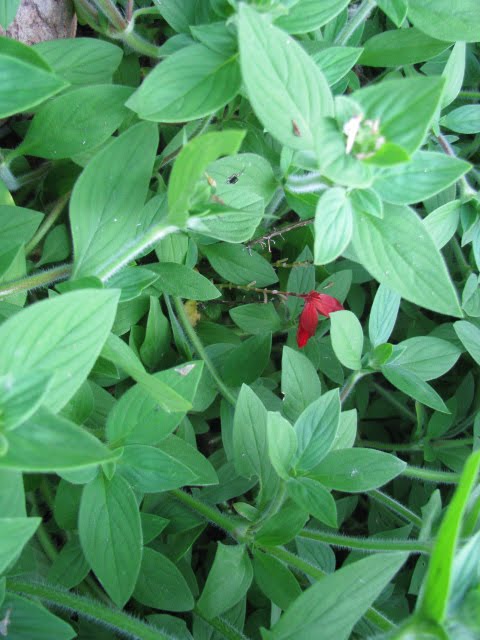 Can you see a spot of red in this picture? That was once a healthy Salvia plant until this plant took it over. Some of you Florida Bloggers may know this plant as it is common in your area. If I am correct with my identification that is. I believe this plant to be "Mexican Clover" from the Rubiaceae Family. Click HERE to see if you think I am correct.
Guess what else is in the Rubiaceae family? IXORA as Tina guessed on the post from last year! With 7000 plants in this family, difficult to narrow down to Mexican Clover. The info says this plant can be found in Zone-9. Funny as I am in Zone-7B to a possible 8. Also it should die when in temps of 20 degrees. Ha, we had ice and snow in January and it still lives in the Semi-Formal Garden! Amazing how some plants do as they want no matter what the books say. Ha, kind of like me some times.
I like this plant and thus far, I am able to keep it at bay. It is easy to prune as I just pluck it off with my fingers. I don't even need a cutting tool! I find it strange how both batches of this popped up on its own and in gardens as if I planted it there!
I like this pretty lush ground cover and think its A KEEPER, (for now anyway) In the Garden...
Words and Photos Property of In the Garden Blog Team, In the Garden


 The Soil Conservation Service encouraged farmers to plant Kudzu from 1935 to early 1950's to reduce Soil Erosion.The Southeastern United States are the perfect climate for it to thrive. With less freezing temps, the vine continues to grow and is now out of control and taking over everything in its path!

